
POSTED ON Oct 30, 2026

BLOGS
The Permit Is Free. Getting It Right Isn't. (The Border Is the Bottleneck, Part 2)

The Permit Is Free. Getting It Right Isn't. (The Border Is the Bottleneck, Part 2)

Blog

This blog is also available on Substack. Follow along there for addition insights into the artisanal spirits sector and supply chain technology.

TL;DR

  • TTB charges nothing for an importer’s basic permit. In FY2025, 63% of initial permit applications still arrived incomplete or with errors, and initial distilled spirits label submissions had errors about half the time.
  • Follow one pallet of mezcal from Oaxaca to a bar in Phoenix and you count about twenty certificates, registrations, filings and licenses across four regimes. Most run in parallel. Any one can stop the pallet.
  • The fee was never the barrier. The barrier is being the company whose permit, name and records stand behind every shipment, and keeping all of it current.
  • Software is making the filings cheaper, fast. On its own, it doesn’t carry the liability. The legal entity named on the filing and the bond does, and fintech learned in 2024 what happens when nobody can say whose records are whose.

A Pallet Leaves Oaxaca

Picture sixty cases of mezcal, shrink-wrapped on a pallet outside a palenque in the valleys outside Oaxaca City. The agave was harvested years ago. The spirit is distilled, rested, bottled and sold. A bar in Phoenix is waiting for it.

The truck can move. The pallet can’t. Not yet.

Before it goes anywhere, the lot needs a certificate from an accredited conformity body, COMERCAM being the best known, confirming it meets NOM-070, Mexico’s mezcal standard. Every bottle needs the certification seal, applied across the label and the glass. Then this specific shipment needs its own export certificate, because NOM-070 requires one “para cada una de las operaciones de exportación,” for each export operation. COMERCAM says it can issue that certificate within five business days. Read the fine print and the five days only start once the inspection, the lab report and the holograms are already done.

That’s Mexico. Then the pallet needs a US importer holding a federal basic permit, an approved label in that importer’s name, an FDA-registered facility behind it and prior notice filed before it arrives. It needs a customs entry, a bond, duty and federal excise paid or secured, and origin paperwork if anyone wants to claim USMCA treatment. In Arizona it needs a licensed supplier, a licensed wholesaler, and a full 24 hours sitting untouched on that wholesaler’s premises before it can go to the bar. State law says so.

Count it all up and it’s about twenty certificates, registrations, filings and licenses. Most run in parallel, long before the truck leaves. But every one of them names someone. And every one of them can say no.
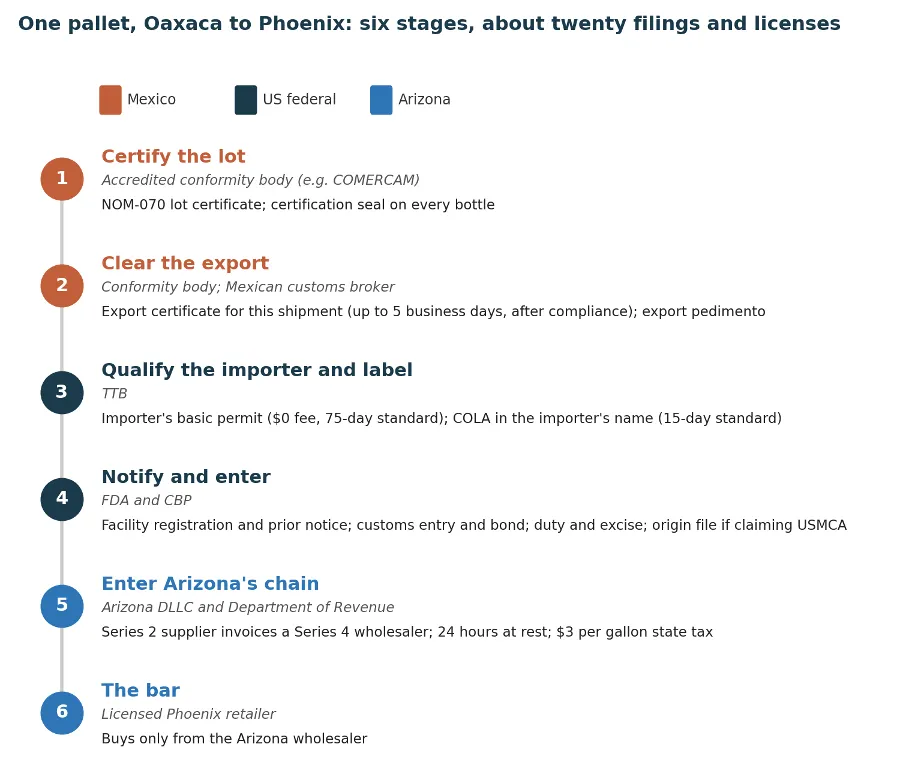
Source: NOM-070-SCFI-2016; COMERCAM certification manual (August 2023); TTB permit guidance and FY2027 Congressional Justification (April 2026); A.R.S. §4-243.01 and §42-3052. Most approvals run in parallel before the truck leaves; stage order is simplified.

‍So what: The pallet doesn’t fail at the border. It fails months earlier, at whichever filing nobody owned. The border is just where you find out.

Free at the Door

Here’s the part that surprises people outside the industry.

TTB, the federal regulator, doesn’t charge for an importer’s basic permit. Its own guidance says so plainly: “There is no fee to apply.” The label approval, the COLA, doesn’t carry a government fee either.

And yet.

In FY2025, 97% of original permit applications were filed electronically. And 63% of initial permit applications still reached TTB incomplete or with errors, according to the agency’s FY2027 budget justification. Digitizing a process isn’t the same as simplifying its rules. That number has sat between 62% and 69% every year since 2021. TTB’s own target is 25%. On the label side, the agency handled nearly 163,000 label applications last year. About 31% of label and formula submissions had an initial error. For distilled spirits labels specifically, TTB says the rate “remains high at around 50 percent.”
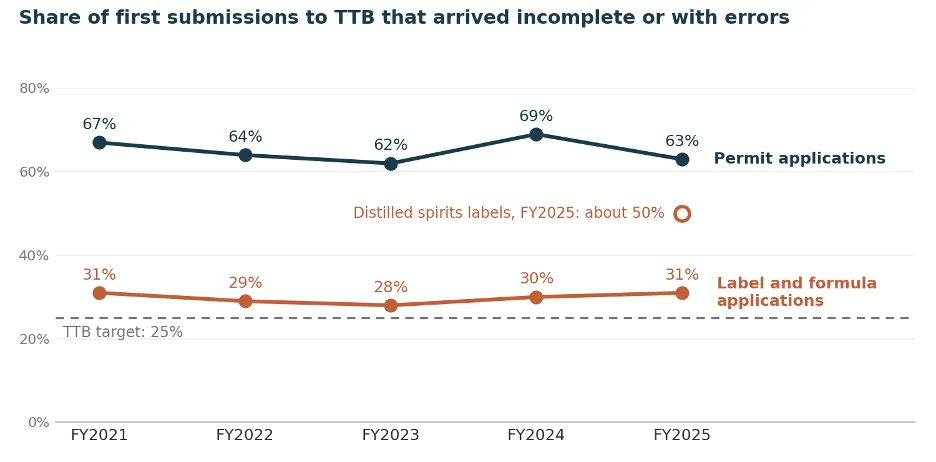
Source: TTB FY2027 Congressional Justification and Budget in Brief, April 2026. “Error” means a first submission that was incomplete or wrong, including ones later corrected and approved.

To be fair to the system, an error isn’t a rejection. TTB counts any submission that comes in incomplete or wrong, including ones fixed and approved later. And the averages are better than the error rate suggests. In FY2025, label applications averaged about seven days, and 92% met TTB’s 15-day standard. Original permits averaged 50 days, with 82% inside the 75-day standard.

So an error usually doesn’t cost you a quarter. It costs you a review cycle, and it turns your launch date from a plan into a guess. Run the math on what a slipped date does to inventory you’ve already paid for.

What a slipped date costs, before lost sales

Illustrative model on $100,000 of landed inventory: value × annual carrying rate × days ÷ 365. The 15% to 30% carrying rate is a common planning assumption (Intuit, 2022), not an alcohol benchmark; 7.37% is the 2025 average US bank prime rate (Federal Reserve, FRED). Lost sales from a missed launch window come on top and depend on your own sell-through.

‍

The clerical layer is also getting easier, and that deserves credit. TTB’s system now automatically clears 68% of eligible import tax-credit claims, up from about 30% when the feature launched in May 2024. Structured forms will take more of the typing away. That’s good news. It also tells you exactly which providers are exposed: the ones whose value was mostly filling in forms.

So the gate is free, and getting easier to reach. Walking through it correctly, the first time, is still the rare event.

So what: When a filing is free, nobody budgets for it, and that’s exactly why it goes wrong. Most brands treat compliance as paperwork. TTB’s own numbers say it behaves more like a skill, and one most first-time filers don’t have.

Four Regimes, One Name on the Paperwork

Strip the pallet’s journey down and four separate systems are watching it. Each has its own gatekeeper, its own documents and its own way of punishing a mistake.

Four regimes, one pallet
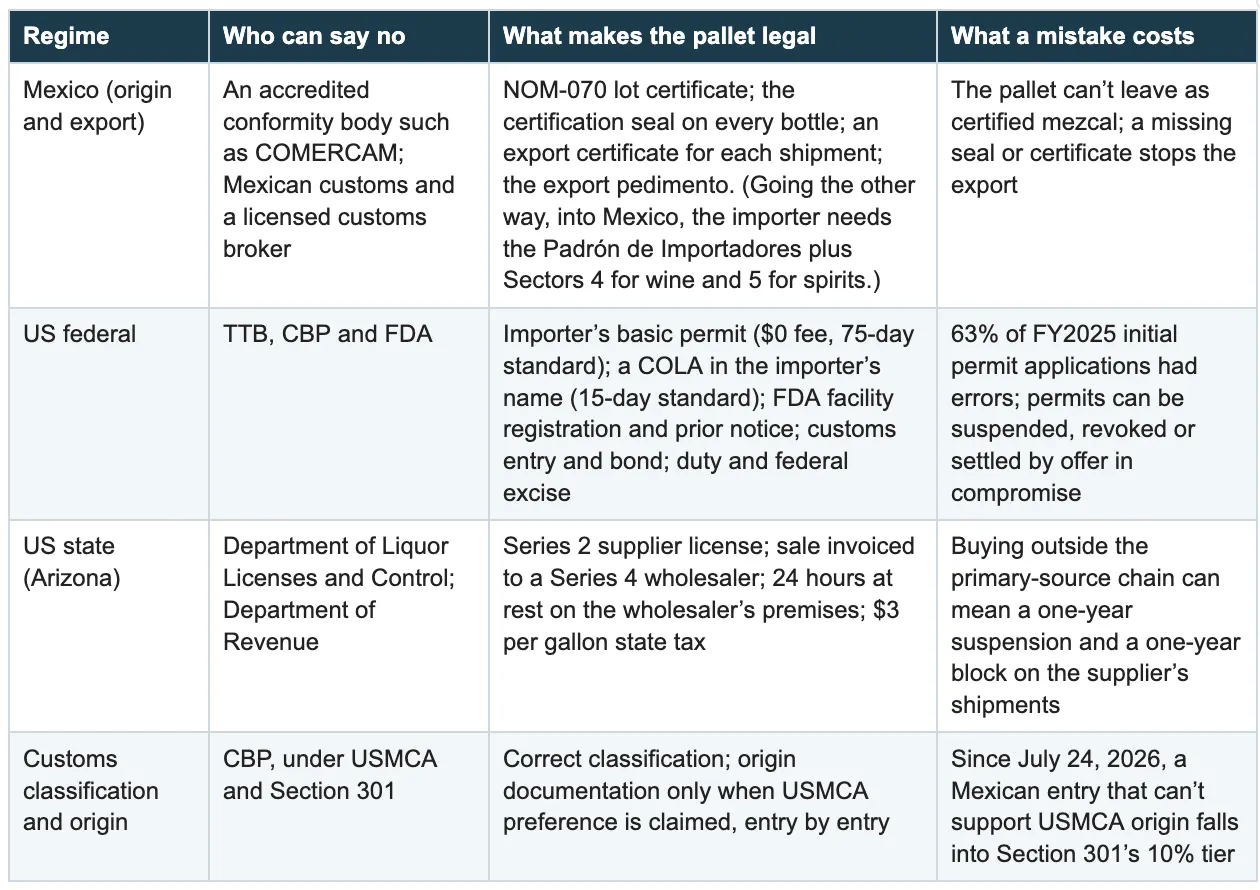
Source: NOM-070-SCFI-2016 (DOF, February 2017); COMERCAM certification manual, August 2023; TTB permit guidance and FY2027 Congressional Justification, April 2026; A.R.S. §4-209, §4-243.01 and §42-3052; USTR Section 301 notice, July 2026; NOR locked language for Mexico importer registration.

The connective tissue is liability. An importer of record doesn’t just upload documents for you. It puts its permit, its name and its records behind your transaction. If the label claim doesn’t match the formula, if the invoice and the origin claim don’t reconcile, if a sale looks like consignment, it’s that company’s permit at risk. TTB can accept an offer in compromise instead of suspending or revoking a permit, and it does. Treasury’s inspector general reported in May 2024 that one trade-practice case TTB closed in FY2023 ended in a $350,000 offer in compromise. The company wasn’t named. In 2019, TTB accepted the same amount from a beer distributor over consignment sales with a right of return.

Even the bond behind an import has a minimum. CBP generally sets a continuous import bond at the greater of $50,000 or 10% of a year’s estimated duties, taxes and fees. The permit can be free. The signature behind it isn’t.

If that sounds abstract, look at what happened in fintech. Synapse was a middleware company connecting consumer finance apps to the licensed banks that actually held the money. It filed for bankruptcy in April 2024, and the records between Synapse, the banks and the apps didn’t reconcile. Starting that May, more than 100,000 people lost access to roughly $265 million that was supposed to be sitting in insured banks. By June, the bankruptcy trustee was estimating a shortfall of $65 million to $96 million. One customer told the court, according to press reports of the hearing, that she expected about $280,000 back and was offered $500.

The banks were licensed. That wasn’t the problem. Nobody could say, quickly and with authority, whose money was whose. The FDIC’s response was to propose daily reconciliation and direct access to the underlying records.

Hold that up against your own supply chain. The permit matters. The ledger may matter more.

Timing follows the same logic. Individual clean approvals take weeks to a few months. Assembling a multi-state US import and distribution stack plus Mexican registrations takes several months, and it can run 12 to 18 months where premises, bonding, application defects or backlogs create dependencies. An established importer adding one straightforward SKU is in a very different position from a brand building the stack for the first time.

So what: The barrier to the border isn’t a fee or a form. It’s the willingness to be the named party, every shipment, across four rulebooks that change on their own schedules. That’s a service you can rent, but you should know you’re renting someone’s liability, not just their software.

Why So Few Software Companies Want the Job

If the filings are this error-prone, you’d expect software to have eaten the problem by now. It’s eaten part of it.

There’s an uncomfortable reason the rest persists. Nobody has shown that TTB wants applicants to fail. But in its February 2022 competition report, Treasury flagged label preapproval, permitting and state distribution rules among possible barriers for smaller firms, and the Justice Department told regulators that some state franchise and posting rules raise entry costs. Whatever the intent, complexity works as an incumbent advantage. A fixed compliance burden favors whoever can spread it across the most cases.

So look at who actually operates here and you find hybrids, not apps. Park Street says it handles importing, compliance, customs brokerage and logistics for more than 1,000 brands. LibDib runs as a licensed wholesaler market by market and publishes its price: a 14% to 20% markup plus logistics. In Europe, Bemakers buys the product, resells it and pays the excise and VAT itself.

Software alone doesn’t assume the liability. The legal entity named on the filing or the bond does.

The newest signal came this summer. Southern Glazer’s, the largest distributor in the country, launched Ankaa Global Logistics in 2023 as a warehousing and logistics subsidiary built for beverage alcohol. In August 2026, Ankaa signed an agreement with Helmsman Imports, a New York importer of record that handles compliance filings, receivables, chargebacks and label approvals on its own platform. Ankaa supplies the warehouses. Helmsman stays the importer. Southern Glazer’s called Helmsman’s model “a natural fit for what we’re building at Ankaa.”

Notice what that deal is. It’s not software replacing the license. It’s the license, the warehouse and the software being bolted together into infrastructure that other brands plug into. That’s the bundle from Part 1, coming apart and being reassembled as layers.

Full disclosure again: Maguey Exchange, the company I run, is the trade operating layer for artisanal spirits and wine, and it lives in this layer, holding the import, distribution and export licenses that move artisanal producers and brands across Latin America, the US and Europe. Weigh my view accordingly.

So what: Standardized processing and transferable liability are two different products. Software is driving the price of the first toward zero. The second stays expensive, because somebody’s permit has to be on the line. Price your importer on which one you’re actually buying.

What to Ask Before You Sign

The fair counterargument is that all of this gets easier. TTB expects its new myTTB permitting system and simpler requirements to bring error rates closer to target in FY2027. A repeat shipment of an unchanged SKU, through the same importer and wholesaler, is mostly routine. And yes, an experienced brand can get its own permit. Outsourcing is a choice, not a federal mandate.

All true. None of it changes who answers when something goes wrong.

There’s also a detail most founders never check. Pull your label approvals and look at the applicant named on each one. If it isn’t you, get it in writing whether a replacement importer could use that approval or would have to refile. Your permission to sell that bottle may live in someone else’s account. That’s fine when the relationship works. It’s the first thing you discover when it doesn’t, which is the lesson every brand that sold through RNDC learned about its accounts this year.

So before you sign with an importer, or renew, take the fee apart. It usually bundles a few different things, and only some of them are infrastructure.

Infrastructure or toll booth?
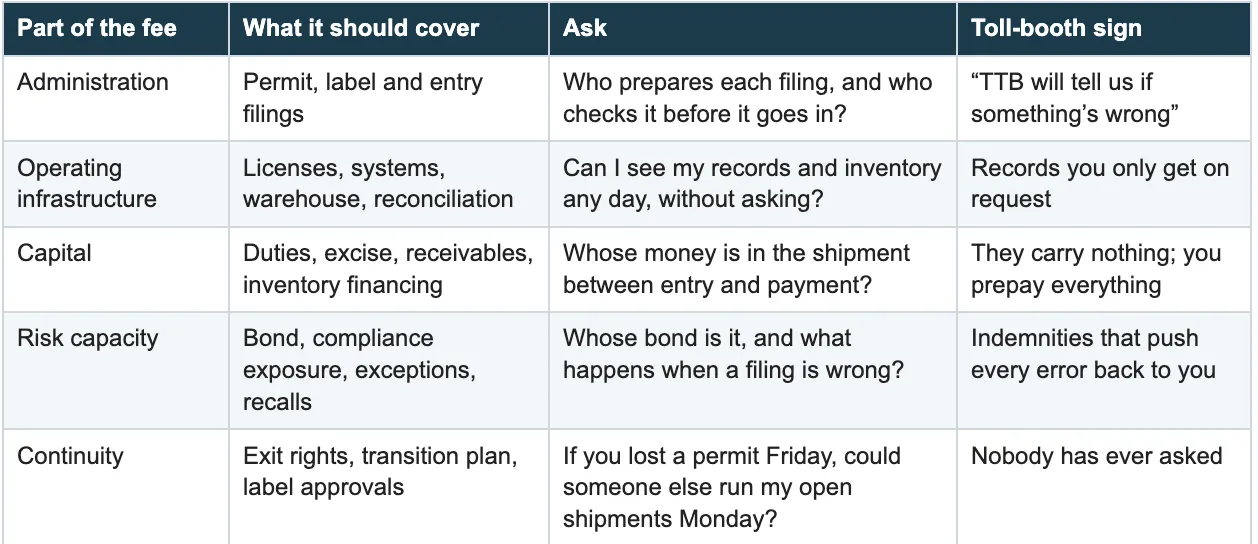
Framework: author’s synthesis, drawing on CBP bond requirements (February 2024) and the FDIC’s post-Synapse recordkeeping proposal (September 2024).

The licensed layer is turning into infrastructure, the way payments and logistics did before it. That’s good news for brands. It means you can rent permission instead of building it. It also means the thing you can’t rent, your accounts, your reorders, your story, matters more than ever. That’s where Part 3 goes next.

Until then, one question.

Which of these four regimes does your current importer actually run in-house, and which does it subcontract?

Read Part 1 of this series here.

This blog is also available on Substack. Follow along there for addition insights into the artisanal spirits sector and supply chain technology.

TL;DR

  • TTB charges nothing for an importer’s basic permit. In FY2025, 63% of initial permit applications still arrived incomplete or with errors, and initial distilled spirits label submissions had errors about half the time.
  • Follow one pallet of mezcal from Oaxaca to a bar in Phoenix and you count about twenty certificates, registrations, filings and licenses across four regimes. Most run in parallel. Any one can stop the pallet.
  • The fee was never the barrier. The barrier is being the company whose permit, name and records stand behind every shipment, and keeping all of it current.
  • Software is making the filings cheaper, fast. On its own, it doesn’t carry the liability. The legal entity named on the filing and the bond does, and fintech learned in 2024 what happens when nobody can say whose records are whose.

A Pallet Leaves Oaxaca

Picture sixty cases of mezcal, shrink-wrapped on a pallet outside a palenque in the valleys outside Oaxaca City. The agave was harvested years ago. The spirit is distilled, rested, bottled and sold. A bar in Phoenix is waiting for it.

The truck can move. The pallet can’t. Not yet.

Before it goes anywhere, the lot needs a certificate from an accredited conformity body, COMERCAM being the best known, confirming it meets NOM-070, Mexico’s mezcal standard. Every bottle needs the certification seal, applied across the label and the glass. Then this specific shipment needs its own export certificate, because NOM-070 requires one “para cada una de las operaciones de exportación,” for each export operation. COMERCAM says it can issue that certificate within five business days. Read the fine print and the five days only start once the inspection, the lab report and the holograms are already done.

That’s Mexico. Then the pallet needs a US importer holding a federal basic permit, an approved label in that importer’s name, an FDA-registered facility behind it and prior notice filed before it arrives. It needs a customs entry, a bond, duty and federal excise paid or secured, and origin paperwork if anyone wants to claim USMCA treatment. In Arizona it needs a licensed supplier, a licensed wholesaler, and a full 24 hours sitting untouched on that wholesaler’s premises before it can go to the bar. State law says so.

Count it all up and it’s about twenty certificates, registrations, filings and licenses. Most run in parallel, long before the truck leaves. But every one of them names someone. And every one of them can say no.

Source: NOM-070-SCFI-2016; COMERCAM certification manual (August 2023); TTB permit guidance and FY2027 Congressional Justification (April 2026); A.R.S. §4-243.01 and §42-3052. Most approvals run in parallel before the truck leaves; stage order is simplified.

‍So what: The pallet doesn’t fail at the border. It fails months earlier, at whichever filing nobody owned. The border is just where you find out.

Free at the Door

Here’s the part that surprises people outside the industry.

TTB, the federal regulator, doesn’t charge for an importer’s basic permit. Its own guidance says so plainly: “There is no fee to apply.” The label approval, the COLA, doesn’t carry a government fee either.

And yet.

In FY2025, 97% of original permit applications were filed electronically. And 63% of initial permit applications still reached TTB incomplete or with errors, according to the agency’s FY2027 budget justification. Digitizing a process isn’t the same as simplifying its rules. That number has sat between 62% and 69% every year since 2021. TTB’s own target is 25%. On the label side, the agency handled nearly 163,000 label applications last year. About 31% of label and formula submissions had an initial error. For distilled spirits labels specifically, TTB says the rate “remains high at around 50 percent.”

Source: TTB FY2027 Congressional Justification and Budget in Brief, April 2026. “Error” means a first submission that was incomplete or wrong, including ones later corrected and approved.

To be fair to the system, an error isn’t a rejection. TTB counts any submission that comes in incomplete or wrong, including ones fixed and approved later. And the averages are better than the error rate suggests. In FY2025, label applications averaged about seven days, and 92% met TTB’s 15-day standard. Original permits averaged 50 days, with 82% inside the 75-day standard.

So an error usually doesn’t cost you a quarter. It costs you a review cycle, and it turns your launch date from a plan into a guess. Run the math on what a slipped date does to inventory you’ve already paid for.

What a slipped date costs, before lost sales

Illustrative model on $100,000 of landed inventory: value × annual carrying rate × days ÷ 365. The 15% to 30% carrying rate is a common planning assumption (Intuit, 2022), not an alcohol benchmark; 7.37% is the 2025 average US bank prime rate (Federal Reserve, FRED). Lost sales from a missed launch window come on top and depend on your own sell-through.

‍

The clerical layer is also getting easier, and that deserves credit. TTB’s system now automatically clears 68% of eligible import tax-credit claims, up from about 30% when the feature launched in May 2024. Structured forms will take more of the typing away. That’s good news. It also tells you exactly which providers are exposed: the ones whose value was mostly filling in forms.

So the gate is free, and getting easier to reach. Walking through it correctly, the first time, is still the rare event.

So what: When a filing is free, nobody budgets for it, and that’s exactly why it goes wrong. Most brands treat compliance as paperwork. TTB’s own numbers say it behaves more like a skill, and one most first-time filers don’t have.

Four Regimes, One Name on the Paperwork

Strip the pallet’s journey down and four separate systems are watching it. Each has its own gatekeeper, its own documents and its own way of punishing a mistake.

Four regimes, one pallet

Source: NOM-070-SCFI-2016 (DOF, February 2017); COMERCAM certification manual, August 2023; TTB permit guidance and FY2027 Congressional Justification, April 2026; A.R.S. §4-209, §4-243.01 and §42-3052; USTR Section 301 notice, July 2026; NOR locked language for Mexico importer registration.

The connective tissue is liability. An importer of record doesn’t just upload documents for you. It puts its permit, its name and its records behind your transaction. If the label claim doesn’t match the formula, if the invoice and the origin claim don’t reconcile, if a sale looks like consignment, it’s that company’s permit at risk. TTB can accept an offer in compromise instead of suspending or revoking a permit, and it does. Treasury’s inspector general reported in May 2024 that one trade-practice case TTB closed in FY2023 ended in a $350,000 offer in compromise. The company wasn’t named. In 2019, TTB accepted the same amount from a beer distributor over consignment sales with a right of return.

Even the bond behind an import has a minimum. CBP generally sets a continuous import bond at the greater of $50,000 or 10% of a year’s estimated duties, taxes and fees. The permit can be free. The signature behind it isn’t.

If that sounds abstract, look at what happened in fintech. Synapse was a middleware company connecting consumer finance apps to the licensed banks that actually held the money. It filed for bankruptcy in April 2024, and the records between Synapse, the banks and the apps didn’t reconcile. Starting that May, more than 100,000 people lost access to roughly $265 million that was supposed to be sitting in insured banks. By June, the bankruptcy trustee was estimating a shortfall of $65 million to $96 million. One customer told the court, according to press reports of the hearing, that she expected about $280,000 back and was offered $500.

The banks were licensed. That wasn’t the problem. Nobody could say, quickly and with authority, whose money was whose. The FDIC’s response was to propose daily reconciliation and direct access to the underlying records.

Hold that up against your own supply chain. The permit matters. The ledger may matter more.

Timing follows the same logic. Individual clean approvals take weeks to a few months. Assembling a multi-state US import and distribution stack plus Mexican registrations takes several months, and it can run 12 to 18 months where premises, bonding, application defects or backlogs create dependencies. An established importer adding one straightforward SKU is in a very different position from a brand building the stack for the first time.

So what: The barrier to the border isn’t a fee or a form. It’s the willingness to be the named party, every shipment, across four rulebooks that change on their own schedules. That’s a service you can rent, but you should know you’re renting someone’s liability, not just their software.

Why So Few Software Companies Want the Job

If the filings are this error-prone, you’d expect software to have eaten the problem by now. It’s eaten part of it.

There’s an uncomfortable reason the rest persists. Nobody has shown that TTB wants applicants to fail. But in its February 2022 competition report, Treasury flagged label preapproval, permitting and state distribution rules among possible barriers for smaller firms, and the Justice Department told regulators that some state franchise and posting rules raise entry costs. Whatever the intent, complexity works as an incumbent advantage. A fixed compliance burden favors whoever can spread it across the most cases.

So look at who actually operates here and you find hybrids, not apps. Park Street says it handles importing, compliance, customs brokerage and logistics for more than 1,000 brands. LibDib runs as a licensed wholesaler market by market and publishes its price: a 14% to 20% markup plus logistics. In Europe, Bemakers buys the product, resells it and pays the excise and VAT itself.

Software alone doesn’t assume the liability. The legal entity named on the filing or the bond does.

The newest signal came this summer. Southern Glazer’s, the largest distributor in the country, launched Ankaa Global Logistics in 2023 as a warehousing and logistics subsidiary built for beverage alcohol. In August 2026, Ankaa signed an agreement with Helmsman Imports, a New York importer of record that handles compliance filings, receivables, chargebacks and label approvals on its own platform. Ankaa supplies the warehouses. Helmsman stays the importer. Southern Glazer’s called Helmsman’s model “a natural fit for what we’re building at Ankaa.”

Notice what that deal is. It’s not software replacing the license. It’s the license, the warehouse and the software being bolted together into infrastructure that other brands plug into. That’s the bundle from Part 1, coming apart and being reassembled as layers.

Full disclosure again: Maguey Exchange, the company I run, is the trade operating layer for artisanal spirits and wine, and it lives in this layer, holding the import, distribution and export licenses that move artisanal producers and brands across Latin America, the US and Europe. Weigh my view accordingly.

So what: Standardized processing and transferable liability are two different products. Software is driving the price of the first toward zero. The second stays expensive, because somebody’s permit has to be on the line. Price your importer on which one you’re actually buying.

What to Ask Before You Sign

The fair counterargument is that all of this gets easier. TTB expects its new myTTB permitting system and simpler requirements to bring error rates closer to target in FY2027. A repeat shipment of an unchanged SKU, through the same importer and wholesaler, is mostly routine. And yes, an experienced brand can get its own permit. Outsourcing is a choice, not a federal mandate.

All true. None of it changes who answers when something goes wrong.

There’s also a detail most founders never check. Pull your label approvals and look at the applicant named on each one. If it isn’t you, get it in writing whether a replacement importer could use that approval or would have to refile. Your permission to sell that bottle may live in someone else’s account. That’s fine when the relationship works. It’s the first thing you discover when it doesn’t, which is the lesson every brand that sold through RNDC learned about its accounts this year.

So before you sign with an importer, or renew, take the fee apart. It usually bundles a few different things, and only some of them are infrastructure.

Infrastructure or toll booth?

Framework: author’s synthesis, drawing on CBP bond requirements (February 2024) and the FDIC’s post-Synapse recordkeeping proposal (September 2024).

The licensed layer is turning into infrastructure, the way payments and logistics did before it. That’s good news for brands. It means you can rent permission instead of building it. It also means the thing you can’t rent, your accounts, your reorders, your story, matters more than ever. That’s where Part 3 goes next.

Until then, one question.

Which of these four regimes does your current importer actually run in-house, and which does it subcontract?

Read Part 1 of this series here.