

This blog is also available on Substack. Follow along there for addition insights into the artisanal spirits sector and supply chain technology.
TL;DR
- When RNDC left California, most of the wineries that answered a WineBusiness survey moved straight to the two biggest remaining distributors. They swapped one landlord for another.
- A distributor never sold one thing. It sold a bundle: the license, the warehouse, the truck, the credit, the selling and the data. RNDC’s collapse showed the bundle can come apart, and that brands only get to keep the pieces they already owned.
- Every industry with a dominant middle eventually has this moment. Records, books, toys and comics all did. The suppliers that came through had already split permission from relationship.
- The license is permission. The account relationship is the asset. For ninety years alcohol sold them as one thing. The brands that win the next decade will rent the first and own the second.
The Wrong Lesson
Here’s the number that stuck with me.
When RNDC announced it was leaving California in 2025, nearly two hundred wineries lost their distributor in the biggest wine market in the country. WineBusiness surveyed the ones making more than 1,000 cases a year. Of those who answered, a quarter signed with Breakthru. Another 22% signed with Southern Glazer’s. Two chose to self-distribute.
Two.
Others went to Regal, Winebow and smaller houses. All of it is a perfectly rational thing to do when you have ninety days and a warehouse full of wine. But notice what happened. A brand that had just watched its distributor walk out of the state responded by handing the same set of responsibilities, the license, the trucks, the accounts, the relationships, to the next company in line.
That’s not a recovery plan. It’s a new lease.
You know the rest of the story by now. RNDC filed Chapter 11 on July 26, 2026 (S.D. Tex., case 26-90737) after exiting California and selling eleven markets, and by September was in accelerated liquidation. Plenty has been written about who got paid and who didn’t. This piece is about something else: what a distributor actually sells you, and which parts of it you should never have handed over.
So what: The instinct after a distributor fails is to find a better distributor. That fixes the symptom. The underlying exposure, one company holding your permission to sell and your relationships with buyers at the same time, survives the switch intact.
Two Brands, One Exit
Put two companies side by side.
Treasury Wine Estates is one of the largest wine companies in the world. In February 2026 it told the Australian Securities Exchange it would buy back the inventory RNDC was holding for it in California, at original sale value, and expected about $65 million in net cash outflow from the deal. Rabobank estimated in June that Treasury had lost about $50 million of California sales, roughly a quarter of its annual revenue in the state.
Nosotros Tequila & Mezcal is a fraction of that size. It had built its California business years earlier on Park Street’s distribution license, selling bottle by bottle to bars in Los Angeles while Park Street handled compliance and logistics. When it moved to RNDC in late 2022, it kept what its chief revenue officer, PJ Dwyer, called “one of the larger independent spirit sales teams in the state of California.” When RNDC gave ninety days’ notice, Nosotros went back to the licensed service model. According to a Park Street case study published in September 2025, it kept more than 2,000 customer relationships and grew about 20% on-premise and about 30% off-premise after the switch.
That case study is Park Street’s own marketing, so weigh the numbers accordingly. The pattern still holds. Dwyer’s advice was blunt: “Invest in resources internally to build your own team, to work on your route to market, and get an understanding of how to be successful on your own.”
The difference between those two outcomes wasn’t size. Treasury had vastly more of everything. The difference was what each company owned when the truck stopped coming.
So what: Scale doesn’t protect you from a distributor failure. Ownership does. A billion-dollar supplier with its inventory and accounts inside someone else’s operation is more exposed than a mid-sized brand that rents the license and keeps the relationships.
What a Distributor Actually Sells
Since 1933, the three-tier system has sold brands a bundle and called it distribution.
Open the bundle up and you find six different things. Permission to sell in a state. A warehouse. A truck and a delivery route. Credit, meaning the distributor pays you and collects from the accounts. A sales force. And the data about who bought what.
Those six things have almost nothing in common. Permission is regulatory and scarce. Warehousing and trucks are logistics, a commodity you can price per case. Credit is finance. Selling is a relationship. Data is an asset that compounds.
For most of the last century the bundle made sense, because there were roughly as many wholesalers as there were wineries and each brand got real attention. That math has broken.
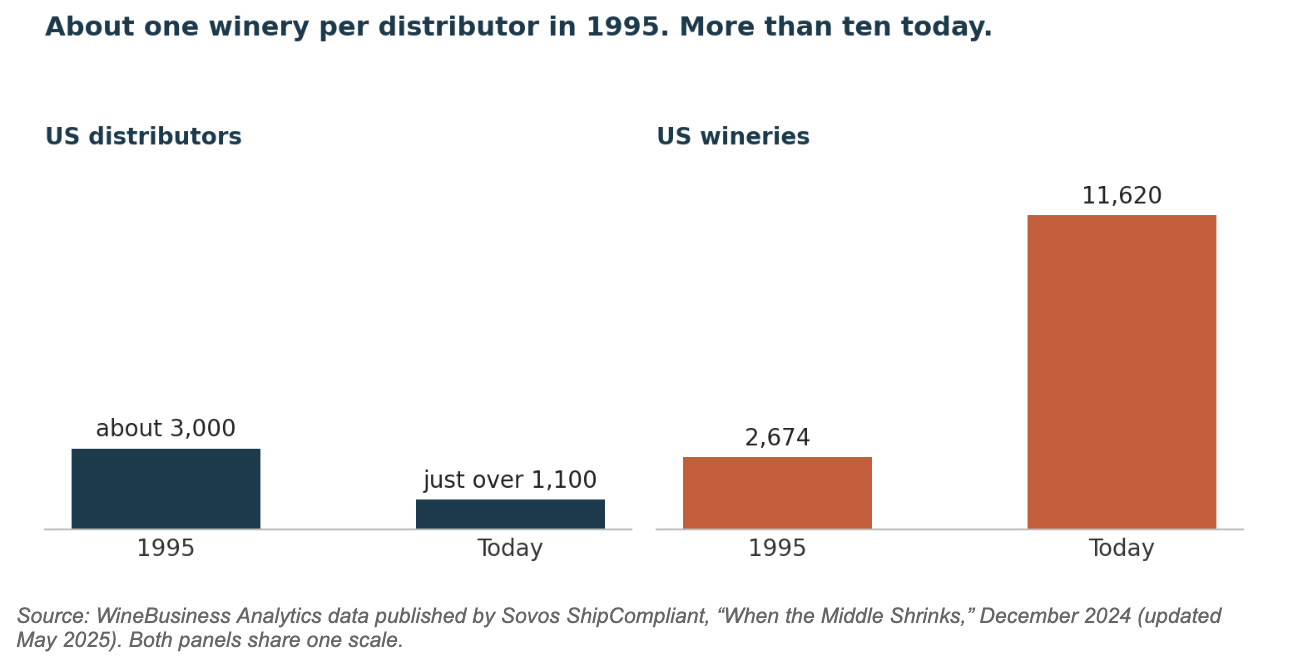
The US had about 3,000 alcohol distributors in 1995 and just over 1,100 by 2024, according to WineBusiness Analytics data published by Sovos ShipCompliant. Wineries went from 2,674 to 11,620 over the same period. Craft distillers multiplied from 280 to 2,753 between 2011 and 2024. The bundle didn’t get cheaper to deliver. The attention inside it got divided by ten.
Here’s the analogy I keep coming back to. When a mall loses its anchor store, the small shops inside don’t lose their inventory. They lose the foot traffic. And they find out, usually too late, that the foot traffic was never theirs. It was rented attention, paid for in rent and margin, and it walked out with the anchor.
So what: Philosophically, the license is permission and the relationship is the asset, and the three-tier system has spent ninety years selling them together. Practically, that means the piece of the bundle you care about most is the piece you’re least likely to control. Paid-to-place versus paid-to-build starts here.
Every Industry Gets This Moment
None of this is unique to wine and spirits. Any industry that routes thousands of suppliers through a few intermediaries eventually watches one of them fail.
When the middle fails
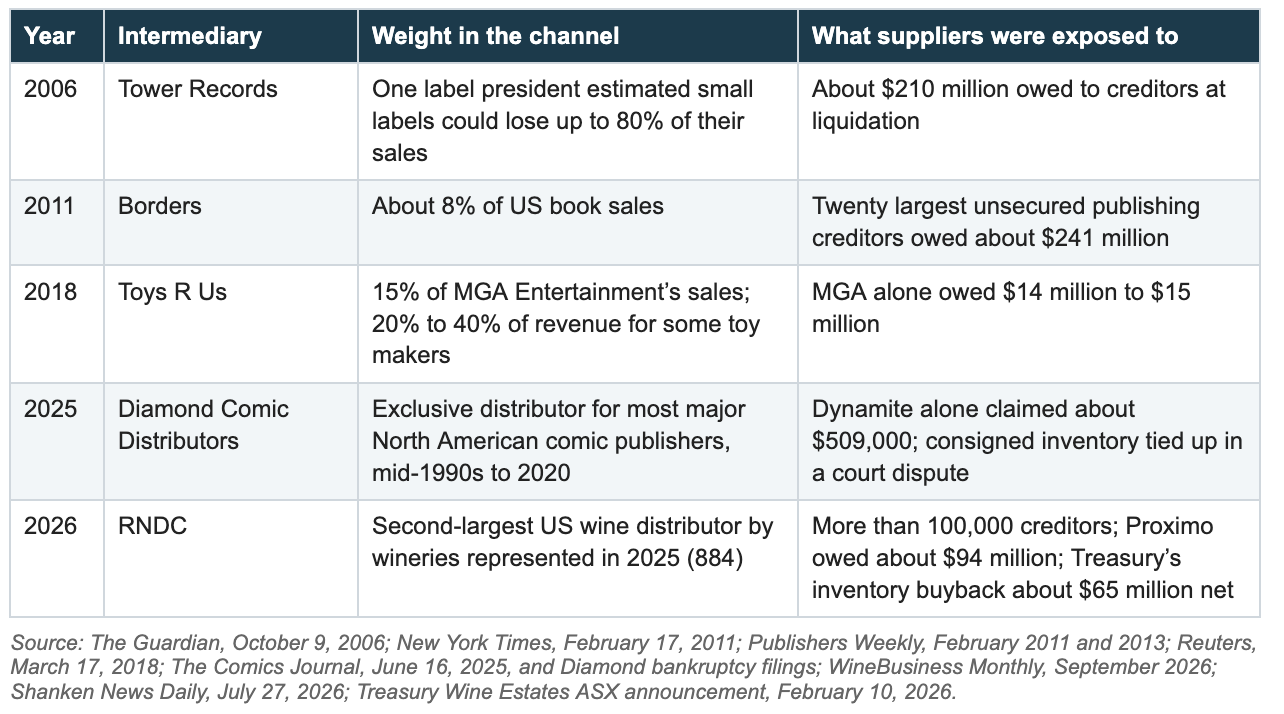
The closest parallel is comics. For roughly twenty-five years, Diamond Comic Distributors was the exclusive distributor for most major North American comic publishers. DC left in 2020. Marvel followed, moving to Lunar Distribution and Penguin Random House. When Diamond filed Chapter 11 in January 2025, those alternative routes are what kept many retailers ordering. Publishers still routing through Diamond had a different year: unpaid sales, a buyer of the business that said it wouldn’t pay for anything sold before it took over, and consigned inventory caught up in a dispute with the bankruptcy estate.
The product was fine. The comics were still on the shelves. What failed was access, and access was the one thing those publishers had outsourced completely.
Records, books and toys followed the same script. The supplier’s exposure was never just the unpaid invoice. It was the share of its customers it could only reach through one door.
So what: When the middle fails, product rarely gets lost. Access does. Investors should price a brand on the accounts it can reach without its distributor, not on its distributor’s footprint. That’s the documentation premium in practice, and it’s why the data room is the exit.
The License Becomes a Layer
So what does the bundle look like when it comes apart for good?
Look at payments. To move money for customers in the United States, a company needs money transmitter licenses across 50 states plus DC. One 2025 practitioner estimate puts the fees and professional costs at about $570,000, plus more than $8 million in aggregate minimum bonding, and the process can take one to three years. Most businesses never do it. They plug into Stripe, which holds the licenses, carries the compliance and lets the merchant own the customer.
The license became a layer. The relationship stayed with the business.
Alcohol is heading the same way, and Nosotros is a working example. It rented the regulated parts, the license, the compliance and the logistics, and owned the parts that compound: the sales team, the accounts, the reorder history. In June 2026, Rabobank analyst Bourcard Nesin described large suppliers moving away from one-distributor national deals toward picking the best partner state by state, and put it in one line: “The best athlete must be the brand, not the distributor.”
Full disclosure: Maguey Exchange, the company I run, is the trade operating layer for artisanal spirits and wine, which means we’re in the business of being that rented layer at the border. Read the rest with that in mind. The point stands on its own either way.
The practical test is simple. Take your current distributor apart, piece by piece, and decide what you should be renting and what you should own.
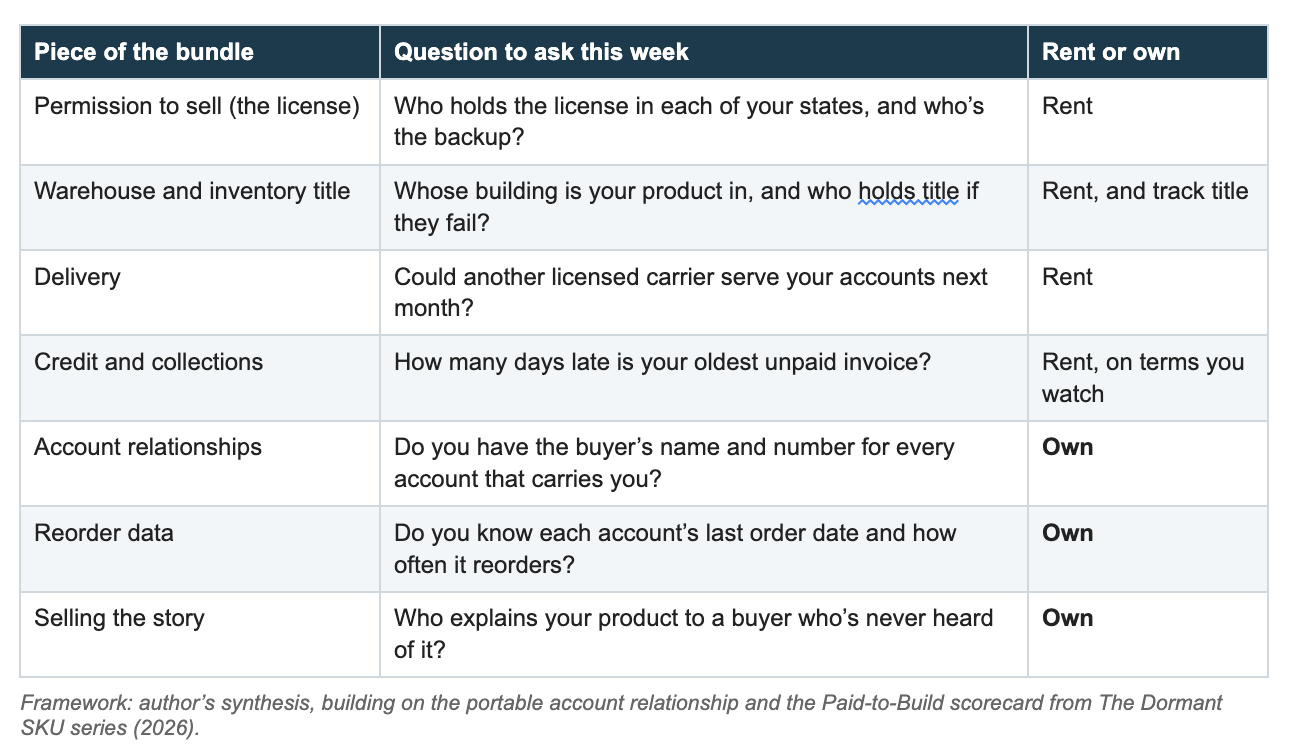
So what: Count the rows in the “own” column you actually control today. If the answer is zero, your brand is a SKU in someone else’s system. If it’s three, you have a portable account relationship, and a distributor failure becomes a logistics problem instead of an existential one.
What 2027 Rewards
The distribution tier will keep consolidating. That’s not a prediction about any one company. It’s what happens when volume rises, value per bottle falls and fewer houses carry more brands.
In that world the license gets cheaper to rent, because more people will offer it as a service. The relationship gets more valuable, because fewer distributors will spend rep time building it for you. The reorder is the only vote that counts, and the brands that can see their own votes will be the ones that can choose their partners instead of waiting to be chosen.
The hardest piece of the bundle to rent is the one at the border. For anyone importing agave spirits, rum or European wine, permission starts before the product reaches a US warehouse, with an importer of record and a stack of registrations most brands never see. That’s where Part 2 picks up.
Until then, one question.
If your distributor’s parent company filed tomorrow, how many of your accounts could you reach by Friday?
Read Part 2 of this series here.
