

This blog is also available on Substack. Follow along there for addition insights into the artisanal spirits sector and supply chain technology.
TL;DR
Eighteen months after the truck, one of our two agave brands got an acquisition offer and the other got a fire sale. The buyer wasn’t paying for the recipe or the trademark. It was paying for demand it could verify and take with it, and it priced everything it couldn’t verify into an earn-out. That asset is invisible until you measure it, and the money to measure it is already leaving your P&L every month. This is what the buyer is actually asking, how to build the proof, where the budget comes from, and what the finished asset is worth. Both brands are composites. The multiples aren’t.
The Offer
Two agave brands. You’ve met them. Same truck, same distributor, the same flat depletion report on the same morning, a year and a half ago. One founder wired herself into her accounts and kept them when the distributor left the state. The other rented a broker and lost the market in a week.
Here’s how it ends. Brand B gets an acquirer. A real one, with a real number, and most of that number is cash on close. Brand A is trying to sell too, quietly, because the runway is short. One group passes. Another offers a fraction of what he expected, and almost all of it is contingent on results he’d have to deliver after the sale. Same liquid, once. One of them is an asset now. The other is inventory with a story attached.
That’s the whole twins story, resolved. The rest of this piece is about you, because the distance between those two offers isn’t luck, and you can close it before anyone asks to see your books.
The Buyer’s Real Question
Nobody tells a founder this until the term sheet is on the table. The acquirer isn’t buying your recipe. Recipes are cheap. It isn’t buying your trademark, your bottle, or the medals on your website. It isn’t even buying your distributor, because it can swap a distributor in a week and has probably lined up three.
Every line of diligence comes back to one question the buyer rarely says out loud: if your distributor disappeared tomorrow, would the customers come with you? That’s the portable account relationship from Part 2, and at the exit it stops being a nice idea and becomes the line the valuation hangs from.
Picture the two data rooms. Brand B’s has an exportable, account-by-account depletion history going back two years, with reorder cadence next to every name, direct contacts for the buyers, and the tasting notes from the visits that won them. You can open it and see a market. Brand A’s has distributor shipment totals by month, a broker agreement, and a spreadsheet he rebuilt from memory during the exit window because the accounts had only ever lived in the broker’s book and the distributor’s CRM. You can open it and see a warehouse.
By the time you sell, the deck isn’t the product. The data room is the exit. Brand B could hand hers over in a folder. Brand A couldn’t sell the asset because he’d never owned it.
For founders: the day you sell is the day you find out who really owned your accounts. If the answer is your distributor or your broker, you’re not selling a business. You’re selling a label.
The Earn-Out Is a Lie Detector
Here’s the part most founders miss until it’s in the contract. When a buyer can’t verify your demand, it doesn’t walk away. It restructures. Bankers described 2025 as a reset for beverage alcohol deals: multiples compressed, diligence got tougher, and deal structures leaned harder on earn-outs and performance contingencies. Read that carefully. The earn-out is the market’s tool for pricing demand it can’t see.
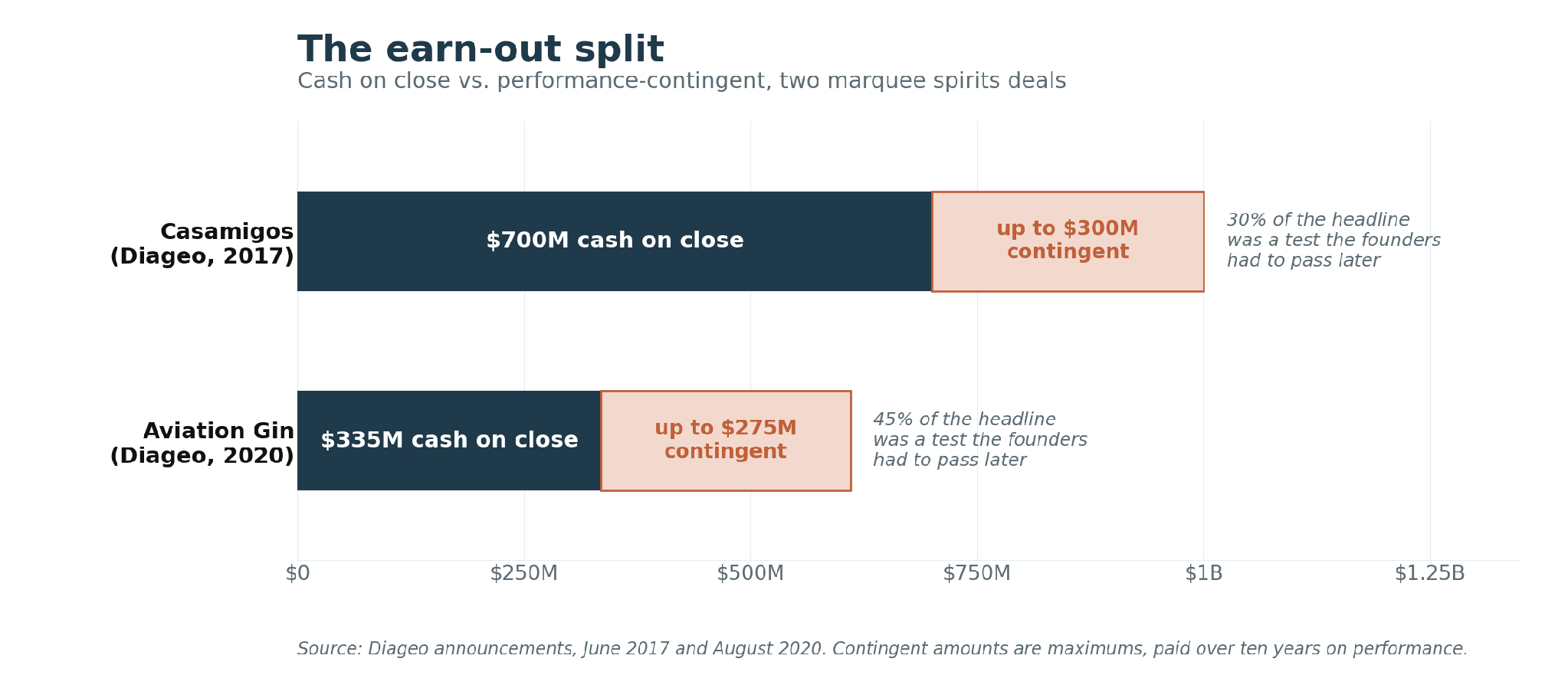
So treat the earn-out as a lie detector. Brand B got cash up front because her reorders were on paper and the buyer could underwrite them. Brand A got a contingent number because the buyer was telling him, in structure, prove it after the fact. Even the marquee deals work this way. Casamigos was a billion dollars, but three hundred million of it was a performance payout. Aviation was up to six hundred and ten million, with two hundred seventy-five of that on earn-out. The more famous the brand, the bigger the check. The less verifiable the demand, the bigger the contingent share of it.
Nobody has published a number that isolates documentation as a priced variable, so take this as the synthesis it is. But the direction is not in doubt. Advisors list weak gross-to-net visibility and promo-dependent growth as drags buyers price in, and they describe multiples as underwritten, not awarded. The buyer pays for what it can verify. Everything else goes into the earn-out, or into the discount.
For investors: read the structure before you read the headline. The cash-on-close share of any offer is the buyer’s honest opinion of how much of the demand is real and transferable.
You Can’t Sell What You Can’t See
To own that asset you have to be able to see it, and most brands can’t. They watch the one number the distributor hands them, shipments, cases that left the distributor’s warehouse, and they mistake it for demand. It isn’t. Depletions are demand, the cases that left the distributor for a retailer. Sell-through is the truth underneath both, the bottle a human actually carried home. You want the last two, and you almost never get them without asking. The distributor has no reason to volunteer the number that shows whether it’s selling your brand or just storing it.
Three numbers, then. Here is who holds each one, what it hides, and how you get it.
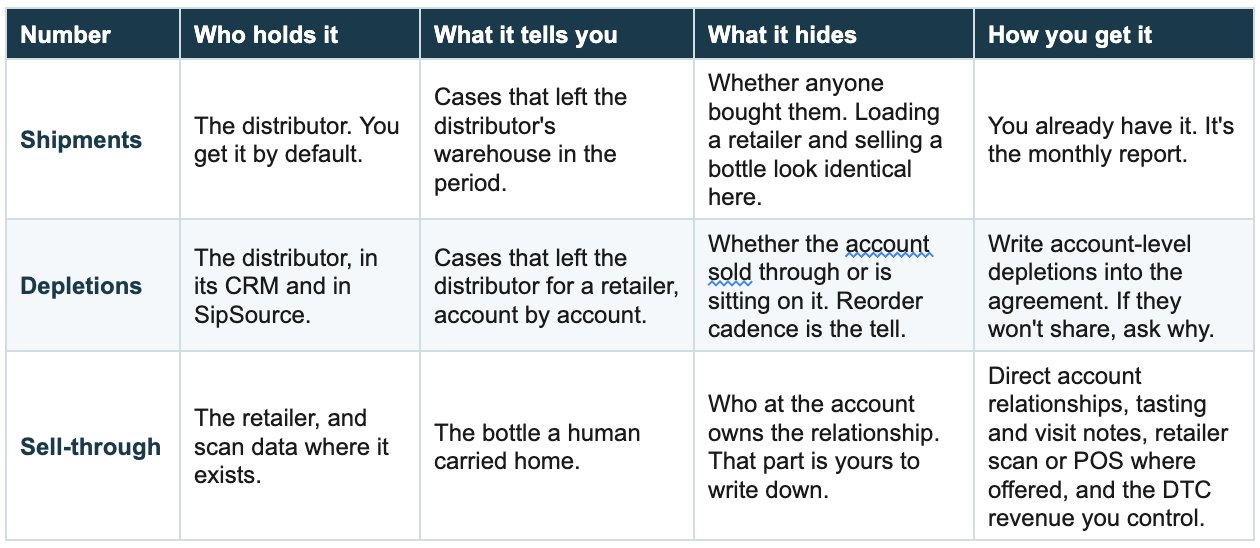
This blindness is structural, not personal. WSWA built SipSource because depletion data otherwise sits with distributors, and a whole category of software now exists whose entire pitch is that once your product leaves the loading dock, you go dark. Nobody founds a company around a problem that isn’t real. What still doesn’t exist is a published dormancy rate for placed craft brands. The data to calculate it sits inside distributor systems. It just never comes out.
Call the space between having that data and acting on it the sales activation gap. Close it and dormancy stops being something you discover a dead quarter too late. It becomes something you catch in a week. Pick one market. Get depletions by account. Watch reorder cadence. When an account’s reorders slip, re-sample and re-pitch. When shipments hold steady but depletions slow, you’re about to overproduce. And when a volume buyer stops asking you to tell him about your brand and starts asking what your pallet price is, the frame has flipped. He already believes the demand. That question is the sound of an asset working.
For operators: ten accounts, depletions by account, reorder frequency. If you can’t see those three things this week, you’re not managing a brand. You’re hoping for one.
Where the Money Comes From
The objection is always the same. This sounds expensive, the distributor already handles compliance, so building your own feels like paying twice.
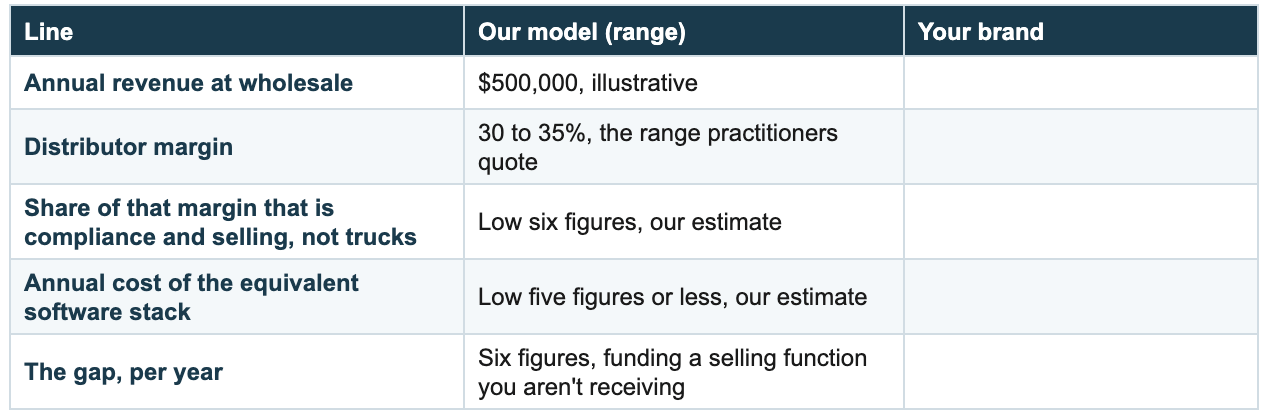
You’re already paying twice. That’s Part 1’s double-paying, and here’s the shape of it. Run the model on a brand doing $500,000 a year. Assume a 30 to 35 percent distributor margin, which is the range practitioners quote. Some of that margin is trucks and warehouses. A meaningful slice is the compliance and selling function you were told came with the deal. Our modeling puts that slice in the low six figures. Meanwhile the technology that does the compliance and depletion-tracking work now sells as low-cost software, priced in the low five figures a year or less. Those are our estimates, not published market figures, so run your own numbers. But the gap doesn’t need to be exact to be six figures, and it sits there every year funding a selling function you aren’t actually receiving. Redirect it.
Here’s the model. The last column is yours.
There’s a cleaner version of distribution that already prices this honestly. Practitioners describe clearing and pass-through structures at roughly half the traditional margin, because everyone at the table understands the sales work is happening at the brand. That’s distribution priced as what it actually is. Logistics.
And once you own the metric, you can point it at anyone you hire. A rep, an agency, a fractional sales lead, it doesn’t matter who. Tie the check to depletions after ninety days instead of placements on day one, and paid-to-place quietly becomes paid-to-build. The number is what makes the accountability real.
For investors: a brand that recaptures the selling margin and holds its reps to a velocity number isn’t spending more than its dormant competitor. It’s spending the same money on an asset instead of a line item.
The Documentation Premium
Now the number Brand B got, and why she got it.
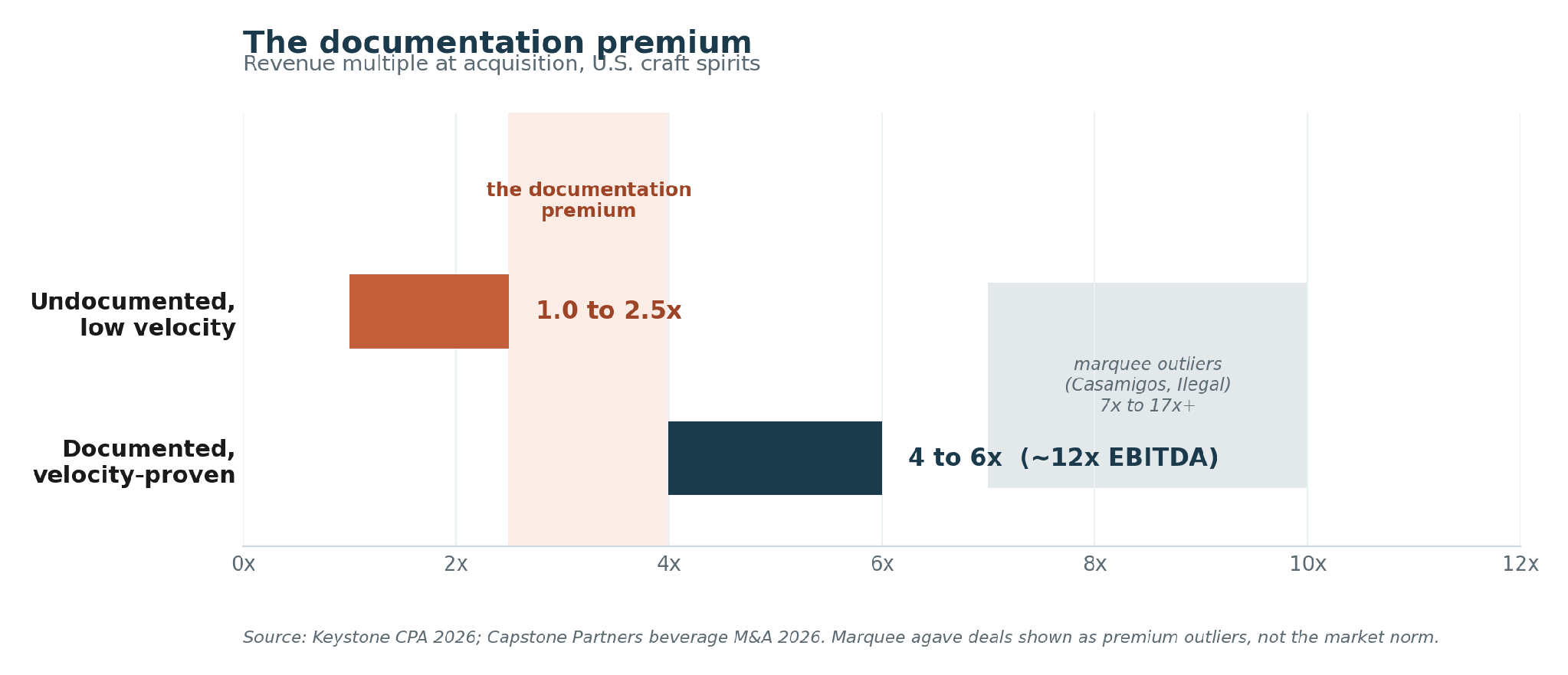
Be careful with valuation folklore. The marquee agave deals get quoted like they’re the rule. Casamigos, Ilegal, the handful that traded somewhere between nine and seventeen times revenue by third-party estimates. They’re the ceiling, not the market. The analyst who ran the Casamigos math called it the Clooney premium and said the industry averages six times revenue, and if you got ten you’d be flying. The honest range, corroborated by multiple 2026 valuation practitioners, is this: a documented, velocity-proven premium craft brand sits around four to six times revenue. A small craft brand that can’t prove who’s buying it, or whether they’ll buy again, transacts at one to two and a half times, if it transacts at all. Beverage-wide EBITDA multiples averaged around twelve times across 2024 and 2025, but that blends every category, so treat it as a ceiling, not a spirits benchmark.
Call that spread the documentation premium. It’s the distance between one-and-a-half and five, and it isn’t a reward for a better product. It’s payment for a sales function that transfers.
The market is pricing this in the open now. In September 2025 Tito’s made the first acquisition in its history, a majority stake in LALO Tequila. Terms weren’t disclosed, so don’t read a multiple into it. Read the reason. LALO’s next phase needed deeper distribution and stronger sales infrastructure, and the buyer was an operator that already owned both. That’s a buyer paying for the sales layer as the thing the brand needed next. Smaller signals point the same way. A micro-cap beverage platform bought control of a spirits sales-and-brand-management agency in early 2026 specifically to bolt selling onto its distribution, a tiny deal, so don’t overread it. And one fractional-sales firm counts roughly nine thousand fractional sales leaders working across the U.S. and Canada, cross-industry and self-reported, so take it as color, not proof. The pattern holds anyway. A market forms around a function the moment people admit it has value.
Be fair about when this isn’t the thing being bought. Big strategics spent 2025 shedding brands for lack of category fit, not lack of velocity. Some deals are capacity plays, a factory not an account book. And a category king like Patrón held a five-billion-dollar valuation through years of nearly flat growth on positioning and shelf leverage alone. If you’re a celebrity brand or you own a category, you get bought for other reasons. For every reader who is neither, owned demand is the asset.
For founders: the brands that get bought hand the buyer a market. The brands that get passed over hand the buyer a warehouse receipt and a story, and get priced accordingly.
What Your Data Room Needs to Hold
You don’t have to be selling to build this. You have to be selling to regret not having built it. Here’s what a buyer will ask for, and why each item moves the number.
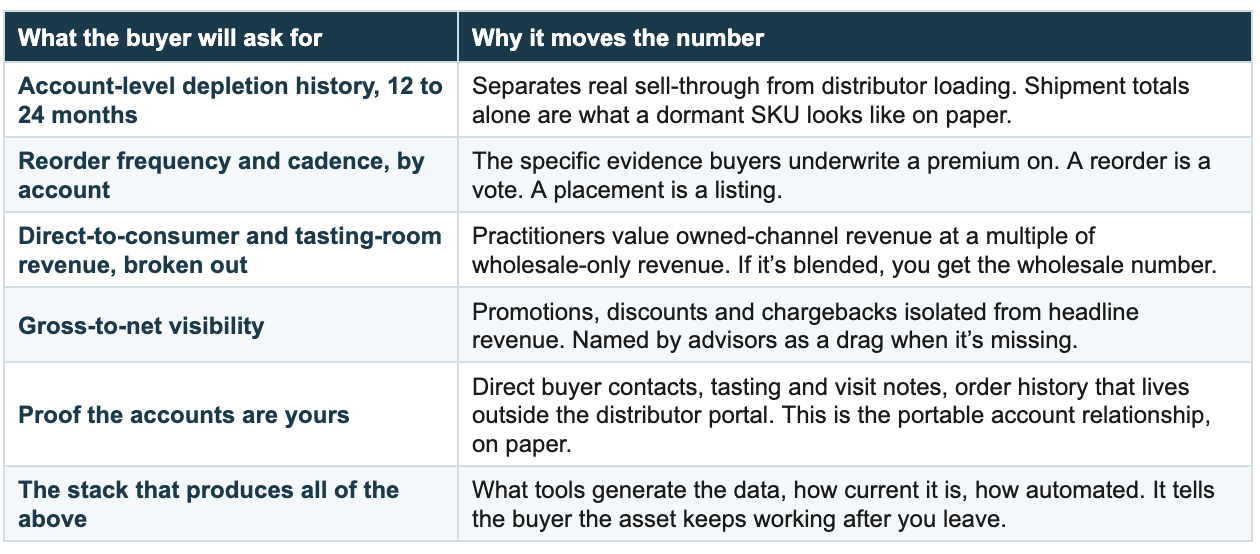
Six items. None of them needs a banker. All of them need someone on your side to own the account relationship and write it down, which is the exact function Part 1 said your distributor was never going to perform and Part 2 showed a founder performing anyway.
Go back to where this started. Part 1 opened with a brand asleep in a warehouse, and I framed that as a logistics problem, product parked with nobody selling it. Look at it again through Brand A’s exit and the warehouse was never the risk. The risk was that the brand’s only proof of life lived in someone else’s filing cabinet. The distributor had the depletions. The broker had the accounts. The founder had a report he didn’t control and a number he couldn’t defend. The dormant SKU and the acquired brand were never two companies. They were one company at two different decisions about who would sell the product and who would own the evidence.
You’ll get one more monthly report before the next distributor decides to leave your state. So open your own data room tonight, before anyone asks to. If your distributor vanished tomorrow, what in that folder proves the customers would come with you?
The Dormant SKU, in three parts. Diagnose it, wake it up, own it.
